
Candyland KYC and Verification Before Withdrawal
 Available in GB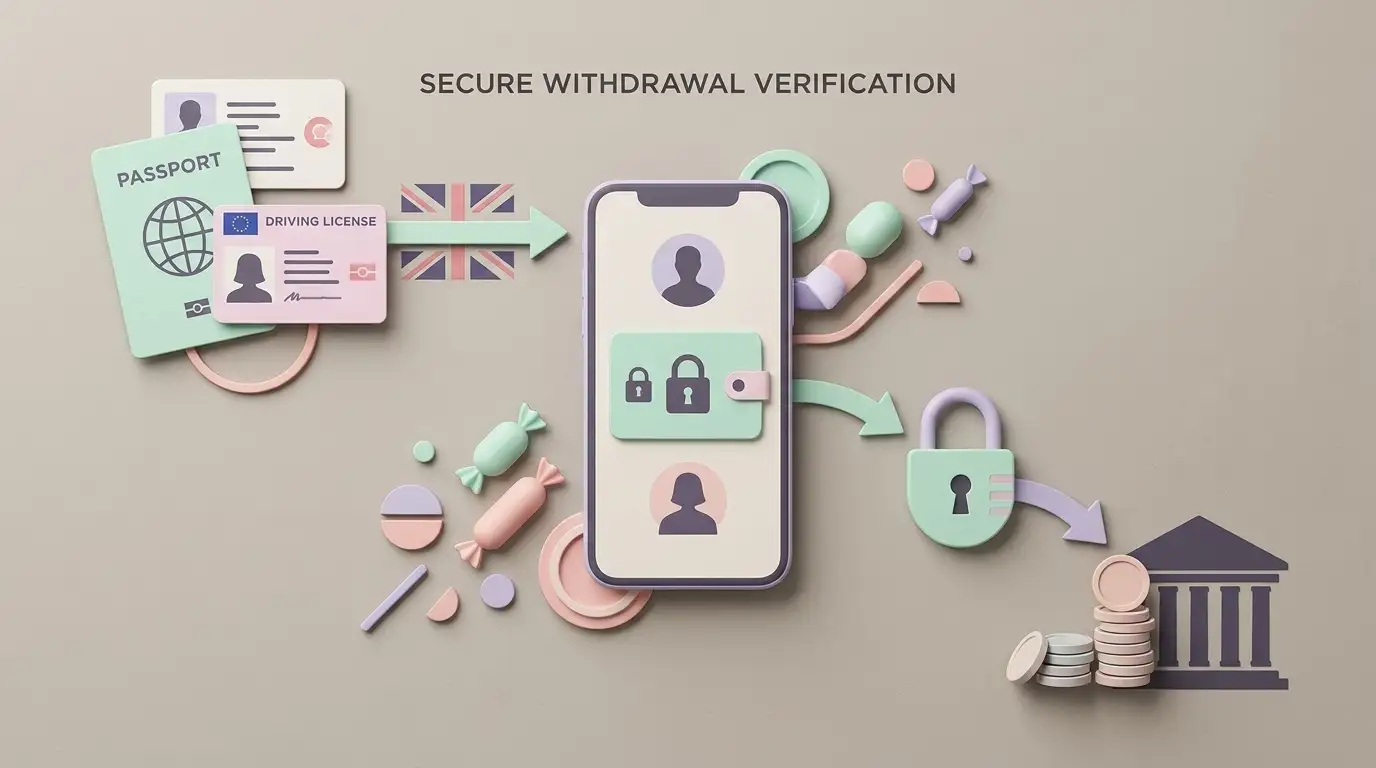
Candyland may request identity, address and payment-method evidence before approving a withdrawal. Its current Banking page lists a copy of ID or passport, a recent utility bill showing the player’s name and registered address, and – for card deposits – a masked copy of the card plus a signed Card Authorisation Form. For Neteller or Skrill, it lists identity and address evidence. The exact request therefore depends on how the account was funded and on the casino’s security checks.
Verification also has a direct financial consequence in Candyland’s published Terms: verified accounts may withdraw up to £1,000 per week, while accounts where documents have not yet been sent are limited to £500 per week. Candyland says accepted documents place the player into the next available payment cycle, so KYC can affect both eligibility for approval and the payout queue.
Table of Contents
- What Candyland currently asks for
- When verification happens
- How verification changes the weekly withdrawal limit
- How to prepare documents without creating avoidable delays
- The 30-day document rule
- Verification and payment ownership
- What verification does not prove
- Bottom line
- Document checklist from Candyland banking information
- Make the submission easy to review
- Related Candyland guides
What Candyland currently asks for
| Document category | Published example | Purpose in the process |
|---|---|---|
| Identity | ID or passport, front and back | Confirms the account holder’s identity. |
| Address | Recent utility bill showing the registered name and address | Supports the address attached to the account. |
| Card evidence | Front and back of a card used to deposit, with middle digits covered | Links a card-funded deposit to the account holder. |
| Card authorisation | Signed Card Authorisation Form | Additional evidence for card-funded accounts. |
Candyland’s Banking page says Neteller or Skrill users need the identity and recent utility-bill documents rather than the card-specific items. These are the casino’s current published categories, not a guarantee that no additional security evidence will ever be requested. The safest preparation is to use documents whose names and addresses match the information already held on the account. If an address document is requested, use a recent document that clearly shows the same registered address rather than sending several unrelated files. If a card copy is requested, follow Candyland’s masking instructions instead of exposing the full number. This reduces unnecessary disclosure while still giving the finance team the evidence described on the Banking page.
When verification happens
The Terms allow Candyland to request documentation for identity verification at any time, including before deposits or withdrawals and when fraud is suspected. For a pending withdrawal, the Terms say approval depends on verification of the required documents and information.
The Banking page says that once the Finance department reviews and approves the documents, the player is added to the next available payment cycle. The Terms add that accepted verification documents place a withdrawal into the queue on the next business day. That sequence is why “withdrawal requested” and “withdrawal ready for processing” can be different points in time. Verification should therefore be treated as a step that can affect both approval and scheduling, not as a formality that happens after the payment has already been released. If the account is likely to need a larger withdrawal, waiting until the request is urgent can leave less time to correct an unreadable image, an address mismatch or a missing payment-method document. Keep the original files and the date sent so you can identify exactly what was provided if support asks for a replacement.
How verification changes the weekly withdrawal limit
Candyland currently publishes two ordinary weekly figures: up to £1,000 for a verified account and up to £500 for an account where documents have not yet been sent. This is one of the clearest reasons to complete requested KYC promptly if you intend to withdraw more than a small amount.
The wider Candyland withdrawal guide explains the other constraints, including the small-deposit 10x rule, Bitcoin-only UK withdrawals and the stated processing window. Those rules are separate from KYC, so completing verification does not remove other withdrawal conditions.
How to prepare documents without creating avoidable delays
- Make sure the name and address shown on evidence match the details registered on the casino account.
- Use clear, readable images rather than cropped or blurred photographs.
- When Candyland requests a card copy, follow its instruction to cover the middle card numbers while leaving the first four and last four visible.
- Send only the categories requested for the payment method you actually used.
- Keep your own record of what was submitted and when.
Candyland’s Banking page specifically asks players sending document images to include their name and username and warns against blurry pictures. These small procedural details matter because an unreadable submission may not complete the verification step.
The 30-day document rule
Candyland’s withdrawal terms say that failure to submit required withdrawal documentation and information within 30 days of the withdrawal request can result in cancellation of that withdrawal. A separate security-verification clause also describes consequences when a requested verification form and personal identification are not returned within 30 days. That 30-day rule makes record-keeping important. Save the withdrawal request date, the date Candyland asked for documents, the date you sent them and any acknowledgement from support or finance. If a document is rejected, ask which requirement was not met and resend only the corrected item. A clear sequence of dates helps distinguish a document problem from the separate withdrawal-processing period stated in the Terms.
The practical lesson is not to leave a document request unanswered while assuming the withdrawal will remain pending indefinitely. If a request is unclear, use the casino’s published support channels to clarify which document category is outstanding rather than guessing.
Verification and payment ownership
Candyland says deposits should be made using a bank account, card, wallet or other payment method registered in the player’s own name. Its public legal material says payment-method ownership is checked at withdrawal. This connects KYC with the earlier deposit trail: identity evidence may be correct while a mismatched funding method still creates a separate problem.
Before depositing, review the Candyland payment methods guide and use a method you control in your own name. That is easier than trying to resolve an ownership mismatch only when funds are ready to be withdrawn.
What verification does not prove
Completing Candyland’s KYC process does not establish that the casino is authorised by the UK Gambling Commission. Verification is an account-security and payment process; regulatory authorisation is a separate question. The broader Candyland Casino UK review keeps those issues separate so an operational account feature is not presented as evidence of UK regulatory status. A practical status question is specific rather than open-ended: ask whether the account is verified, whether any document remains outstanding, whether the pending withdrawal has entered the payment queue and which published limit is currently being applied. Those questions map directly to the stages described in Candyland’s Banking and Terms pages. They also create a useful written record if the answer later changes.
Bottom line
Expect Candyland verification to centre on identity, address and – where relevant – proof connected to the payment method used. The casino’s current published rules make verification material to withdrawals because documents are required for approval and because the ordinary weekly limit is higher for verified accounts than for unverified accounts. Completing KYC does not guarantee an immediate payout and does not remove the other withdrawal rules. Candyland still publishes processing times, minimums, deposit-related cashout conditions and payment-method restrictions that operate separately from identity checks. Verification is best understood as one gate in the withdrawal process: necessary when requested, financially relevant because the weekly limits differ, but not a substitute for reading the rest of the withdrawal terms.
Prepare readable evidence that matches the account details, respond to document requests promptly, and treat verification as one stage of the withdrawal process rather than the end of it. Processing, payout method and other cash-out limits remain governed by the separate withdrawal terms.
Document checklist from Candyland banking information
Candyland’s current banking page gives a more specific first-party document list for a pending withdrawal. It states that the casino can ask for a copy of an ID card or passport, a recent utility bill showing the same name and address as the account, and copies of a credit or debit card used to deposit with most card digits covered. It also refers to a signed Card Authorization Form for card users. For alternative payment methods such as Neteller or Skrill, the page lists identity and address documents rather than the card-copy items.
These are Candyland’s published categories, not a promise that every account will receive exactly the same request. The same banking page says verification documents can also be requested for fraud-prevention purposes, so the account history and payment method can affect what the finance team asks to see.
Make the submission easy to review
The banking instructions ask players to send clear digital pictures and include their name and username. In practice, that means each image should show the full relevant document, remain readable when opened, and avoid glare or blur across the fields needed for verification. For card copies, follow Candyland’s masking instruction rather than exposing the complete card number.
Keep a copy of what you send and note the submission date. If support asks for a replacement image, send the corrected document as a clear follow-up so there is a simple record of which version is current. This does not guarantee a faster approval, but it reduces avoidable back-and-forth caused by unreadable or incomplete files.
Related Candyland guides
candyland casino review; candyland casino withdrawal; candyland casino payment methods; candyland casino support.
Written by the editors at Candyland Casino 3.